

Motte & Bailey Faith
Not literalist religion, not liberal religion, but a gloriously uncertain Third Thing.
“Teach your tongue to say, ‘I do not know,’ lest you be caught up in deceit.”
— Talmud Bavli, Berakhot 4a
“Human reason cannot fully conceive God in His true essence, because of the perfection of God’s essence and the imperfection of our own reason… The inability of our reason to comprehend Him may be compared to the inability of our eyes to gaze at the sun… We cannot comprehend God’s knowledge… our minds cannot grasp it all, for He is His knowledge, and His knowledge is He.”
— Maimonides, Eight Chapters, 8:20
In the ancient Greek agora, rhetoricians might praise or damn each other for their uses, fair or foul, of a known collection of rhetorical devices. This oratorical menagerie included specimens like ekphrasis, synecdoche, or metalepsis.
Today, in the digital agoras of social media, we have something like a debased equivalent. Students of digital rhetoric might identify examples of “gaslighting,” “sea-lioning,” “straw-manning,” “steel-manning,” “tone-policing,” “sanewashing,” et cetera, et cetera, et permulta cetera.
One such contemporary coinage draws delightfully on the medieval: motte-and-bailey arguments.
This rhetorical taxon seems first to have been proposed by philosopher Nicholas Shackel and popularized by Scott Alexander. The idea derives from a “motte-and-bailey” castle. Some medieval castles had a motte, which was a hill on which was built a strongly fortified keep, as well as a bailey: a more spacious, but also more vulnerable, area where much of the castle’s daily life and work took place, as long as all was safe. But whenever an enemy came in force, everyone would flee into the motte, which was cramped but easier to defend.
A rhetorical motte and bailey is when you advance an extreme idea (the bailey), which, in fact, you’re neither able nor willing to defend, and try to get away with it, but if anyone ever challenges you about the wild idea, you fudge or redefine what you had been talking about, as if your original point were a different, related, but more reasonable point (the motte). And you defend that, rather than your original nonsense.
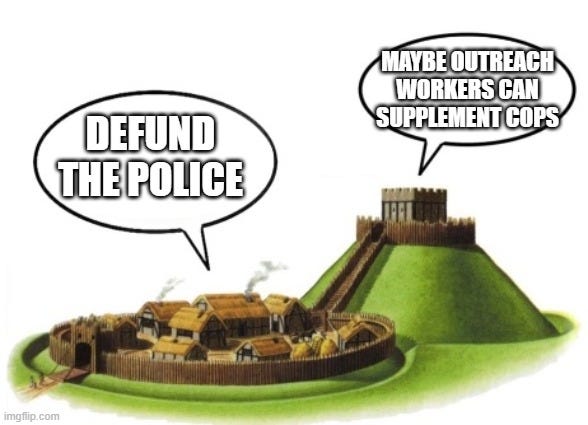
If someone says you’re making a motte-and-bailey argument, it isn’t a compliment. The motte-and-bailey argument has a reputation as fallacious, deceptive, unclear, and generally bad. And for good reason — we should be clear about what we mean, and we should be reasonable right from the beginning of a conversation. We shouldn’t use motte-and-bailey tactics to say one thing for emotional effect when we actually mean something different and less spicy.
However, I think there are situations when we might want to use something like a motte and bailey approach, not to deceive others, but to accurately represent our own uncertainty. We might want to say a word, but have both a motte and a bailey in our mind as possible referents for that word, without being sure which applies.
And let me no longer pretend generality about the one and only such situation I have in mind. The one area in which I fully embrace the motte and bailey as a way of rhetorical life is: theology.
There’s just so much we can’t know for certain. This is true in philosophy, in politics, and in religion, but also in friendship, in romance, in work, in art… In everything.
When it comes to God, perhaps more than in any other case, a range of truths are possible.
Maybe God is something like the classic, Sunday-school God we learned about as kids. Yes, far beyond our abilities to grasp His nature, yes, mysterious and transcendent, but also utterly simple — that all goes with the Sunday school territory — but maybe, just maybe, God, as our premodern ancestors believed in Him, is simply and literally real. Maybe, in some way, as Daniel 7:9 says, He even wears a snow-white garment and has hair like lamb’s wool and sits on a throne. Maybe He cries tears so large they make earthquakes. Maybe heaven is real, and Gehinnom, too, and God told Noah to build an ark…
Or maybe God is more Maimonidean and abstract. Maybe He is a pure, Zen-like knowledge, without the disturbances and imperfections of feelings. Maybe in the purity of His simplicity He actually has less, or none, of what we would call thoughts or plans, let alone desires. Maybe the Torah is an account of high philosophical principles, discerned and written down by the wise for the intellectually elite, and couched in sweet stories so the children won’t get bored and can partially understand.
Maybe God is just, as Spinoza put it, “Deus sive Natura,” “God or Nature.” Maybe the atheist is exactly right that the universe is an unfeeling, unthinking thing, or set of things, that just sort of happens — and “God” is a name we might give to the whole of that reality, and as a way to rally ourselves toward Good Things and comfort ourselves as we make the best of it.
Or maybe all of the above are potential truths at any given time. Maybe Matter is, at bottom, Mind, such that these rival visions of God’s nature actually become true or false because we believe or disbelieve them. Along these lines, readers of this newsletter have already seen my own preferred theory about the nature of God — One Great Field of Consciousness within which all reality is a story or dream. Given the datum of subjective consciousness, I find this theory far more logically plausible than either bog-standard atheism or Sunday-school theism.
So a range of theological possibilities exist.
But, importantly, that range does not extend down to nothing, per se. There is a Minimum Viable God.
The Minimum Viable God is the One who is “just” a metaphor. The socially constructed, metaphorized God of Spinoza, Kaplan, and liberal religion in general, is the ontological minimum. Because liberal religion’s idea of God amounts to saying that for our own good, we’re just going to go ahead and call Reality God, whatever Reality is — even if that Reality is just as disenchanted and mindless as any Dawkins or Dennett says it is. The liberal religionist and the atheist differ less about the substance of reality than about the word we use to label it and the attitude we take in facing it. The atheist is a grumpy pantheist; the liberal religionist is an awestruck atheist.
The atheist might ask: Why does the liberal religionist bother with a God label at all? Well, the liberal religionist might retort, remember please that theology is always sociology in sunglasses and a trenchcoat. What we call the Divine / the Real is really about how we relate to others and build a society together. And that choice to relate to Reality as God is an objectively good sociological choice. Shall I rehash the evidence from social science? I can, though it’s tiresome… Shall I appeal to history, and how Judeo-Christian religiosity built modern liberalism and human rights? Shall I sing my refrain about how restrictive religious traditions empirically build strong communities?
But we shouldn’t need any of that to tell us it’s deeply useful and meaningful to have faith. We can just know it, from experience. In a war, in business, in a play, or in sports, an attitude of faith in success (without complacency) is helpful. One can hold it without being literalistically certain of victory. (There are atheists out there who understand this on the baseball field but forget it when it comes to religion.) There is, from my perspective, no good reason to drop one’s belief level below the Minimum Viable God.
But please don’t misunderstand me as endorsing the Minimum Viable God as being true. I’m just putting a floor on what I think reasonably might be. God may be, and I believe God almost certainly is, much more than a metaphor; my point is just that He absolutely cannot be less.
And if (A) God exists, as not less than as a metaphor, and possibly much more, but with lots of uncertainty; and if (B) either way, believing in and serving God traditionally is objectively good for humanity; it follows that (C) the rational but skeptical person should assuredly believe in and serve God, but without asserting certainty or precision around exactly what or how much this belief means.
This amounts, I suppose, to a kind of this-worldly Pascal’s Wager. One might also describe it as agnostic doxis wedded to faithful praxis. But I’m calling it Motte-and-Bailey Faith.
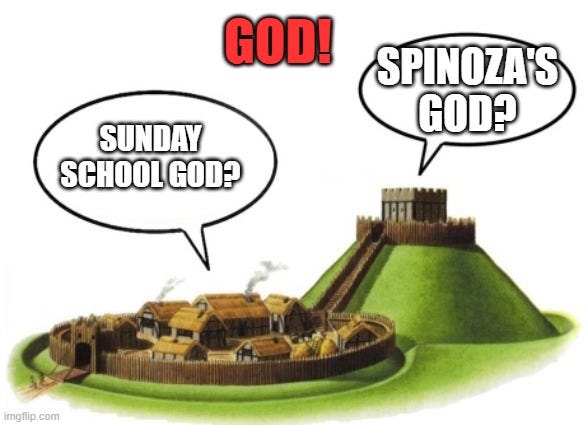
The God of the bailey literally gave the Israelites the Torah on Mount Sinai. He cares, in whatever way a Transcendent Unity can care, about whether or not I keep Shabbat and give charity. He has a plan for each blade of grass, for every human society, for the future of the Jewish people, and for a messianic age and the resurrection of the dead.
The God of the motte doesn’t meet that spec at all, but “He,” or the idea of Him, is a proven and unparalleled way that human societies can organize ourselves to be better, do better, and find meaning.
Which one is true? Or which other place on the wide and meandering path connecting the bailey to the motte is true? Or which place far beyond them is true? The motte and the bailey are not the whole map, after all, they’re just a reminder that the territory is complex…
I hold my own answer about God, but I don’t hold it entirely firmly. And, more importantly, I don’t need a firm answer to maintain my commitment to keeping Shabbat, and giving charity, and calling on the name of God in prayer.
I am not saying it doesn’t matter which kind of theological or biblical truth is true. It matters deeply, and we should keep thinking about it and wrestling with it, as I continually do. What I am saying is that there’s no threat, and much merit, to holding some uncertainty about it, in all directions.
Motte-and-bailey faith allows us to keep our observance and emotional orientation, our way of living in the world, completely firm, religious, traditional, confident, and unconditional, even as our mind is free to explore the many ontological possibilities.
Yes, in most cases, we should eschew motte-and-bailey arguments. We should be reasonable and not deceptive. We should advance ideas we are willing and able to defend. But, ultimately, we’re always being some degree of imprecise. Language itself is fluid. Every word in our imperfect human languages conceals a motte and a bailey, and rarely just one.
“Whereof one cannot speak,” said Wittgenstein, “Thereof one must be silent.” That sounds right, in a rigid sort of way.
However, I think if we want to speak at all, if we want to relate, if we want to test ideas, if we want to live, then we must have some willingness to tolerate the vulnerability of dwelling outside our strongest defenses.
But then, and truly, I don’t know.
Nice thx