

Theistic-Idealist Monism
The Ultimate Solution to Everything (and Practical Solution to Nothing)
“Nor did I wonder at the lily’s white,
Nor praise the deep vermilion in the rose;
They were but sweet, but figures of delight,
Drawn after you, you pattern of all those.”
— William Shakespeare, Sonnet 98
Over the past two years, many of my posts have turned out to be winding paths converging on a single endpoint. I did not plan this. I didn’t have any central thesis in mind when I began this newsletter. Rather, writing this newsletter (along with plenty of reading) just seemed, ineluctably, to lead me over and over to the same idea.
For all my love of Emily Dickinson’s advice (“Tell all the truth but tell it slant”), it behooves me to make one post where I hazard the inelegance of just stating that central idea clearly. So this post is it.
I then add some of the reasons I find this theory appealing, and draw out the (distinct lack of) practical implications. But this time, for once, the idea of theistic-idealist monism is right here at the top of the post, not waiting in ambush at the bottom.
I. The Hypothesis
“The One is all things and not a single one of them… the One is not being, but the generator of being.”
— Plotinus, Enneads, V.2
The most basic level of reality is a singular and universal Consciousness. That one Consciousness is a brute fact of existence, and it is the only brute fact in existence; everything else is a phenomenon within it. All matter, energy, space-time, and the physical laws governing them — as well as every subjective experience of every conscious being — all consist exclusively of activity within the one and only universal Consciousness.
That is the hypothesis in Secularese — i.e., Idealist Monism.
Here is the same hypothesis translated into Religionish — i.e., Theistic-Idealist Monism:1
The universe, and everything in it — all matter, every mind, and any soul that there may be — is nothing more nor less than a thought in the mind of God. Nothing but God is ultimately real. Everything exists within and as a part of God’s mind, and every experience is ultimately and exclusively God’s experience.
II. The Evidence
“I do not claim that idealism is plausible. No position on the mind–body problem is plausible. Materialism is implausible. Dualism is implausible. Idealism is implausible. Neutral monism is implausible. None-of-the-above is implausible. But the probabilities of all of these views get a boost from the fact that one of them must be true.”
— David Chalmers, “Idealism and the Mind-Body Problem”
There is no evidence for idealist monism, theistic or otherwise.
Okay, that’s a little stark…
I don’t, at this time, know of anything that I would call evidence, per se, for this hypothesis. (Please comment if you do.) Nor is it clear to me whether evidence is an achievable goal in the realm of metaphysics. (Please comment: What do you think?)
III. The Argument
“Consciousness is the most conspicuous obstacle to a comprehensive naturalism that relies only on the resources of physical science. The existence of consciousness seems to imply that the physical description of the universe, in spite of its richness and explanatory power, is only part of the truth, and that the natural order is far less austere than it would be if physics and chemistry accounted for everything. If we take this problem seriously, and follow out its implications, it threatens to unravel the entire naturalistic world picture.”
— Thomas Nagel, Mind & Cosmos: Why the Materialist Neo-Darwinian Conception of Nature is Almost Certainly False
What I have, in lieu of evidence, is an argument for considering this hypothesis more likely to be true than any competing theory of the universe. And it is this: Theistic-idealist monism has the most plausible answer to the Hard Problem of Consciousness.
The one thing we can be most sure of is that we exist as a subjective conscious self. (All else we think or perceive could be a mistake, trick, or illusion, cf. Descartes.)
Materialists/physicalists either deny that this is so (illusionism) or maintain that this subjective selfhood is somehow “emergent” in a way that is, in the end, incoherent (“emergent” to whom? You can’t be fooled into thinking you exist to be fooled — again, cf. Descartes). Since physicalism cannot account for subjective consciousness (and, indeed, refuses in principle to engage the subjective) — and since subjective consciousness is the single most certain datum we have — physicalism is severely unsatisfying.
Dualists posit a “soul + body” equation, which many of us find implausible for various reasons, partly because the physical brain and the specifics of mental processing are so clearly intertwined, and partly because the whole thing just seems unparsimonious. A human being isn’t one being, he’s two beings, held together by some very hazy laws of interactivity? The mind (mine, anyway) rebels.
Panpsychism satisfyingly accounts for both matter and mind by suggesting that these are just the objective/external and subjective/internal aspects (respectively) of the same thing — i.e., all matter is externally physical and internally conscious, right down to fundamental particles. But the conscious-atomistic version of panpsychism faces the “combination problem” — how do many individually conscious quarks add up to your united conscious mind instead of just remaining conscious only at the subatomic level?
Idealist monism, which can be seen as a non-atomistic form of panpsychism, sidesteps the combination problem by positing that there’s only one Consciousness, not uncountably many of them. Nothing needs combining in the first place.
Now, this theory faces, in parallel to the combination problem, a division problem — why does each of us seem to have only one individual perspective if we’re all really the same self? Bernardo Kastrup’s solution is that the cosmic consciousness undergoes something roughly akin to dissociation in psychology. A theistic perspective might say, rather, that we have individual perspectives because God is imagining us as individual characters in a story, and within the story we have only one perspective, even though in an ultimate sense we are just part of His larger mind. If you can accept either or both of these rejoinders (a big if, but they work for me), then idealist monism just completely solves the hard problem of consciousness.2
IV. The Benefits
“…For He is the Place of the world, and the world is not His place.”
— Bereshit Rabbah
In addition to accounting for mind and matter better than any other theory, theistic-idealist monism offers other philosophical benefits. I do not argue that these benefits rise to the level of arguments in favor of the theory being plausible. But if the argument from subjective consciousness leads you to grant this theory credence, then once you’ve gone that far, these bonus benefits make the theory all the more appealing.
To wit: Theistic-idealist monism has excellent answers to some of the most difficult and long-standing philosophical debates.
Free Will. There are many reasons to believe (and we certainly perceive) that we freely choose stuff, all the time. But there are many other reasons to believe our choices are all inescapably predetermined. Theistic-idealist monism solves the paradox of free will vs. determinism by saying: Both are correct! We are characters in a story written (well, thought) by God. On God’s level, we are completely predetermined fictional characters; He makes us make all our choices in authoring the story. Within the story, however, on our own level, we are absolutely free, with all the unencumbered choice we could wish. To the extent and on the level that we exist as individuals, we have free choice, and to the extent and on the level that we don’t have free choice, we don’t exist as individuals. Moreover, since our existence is just a sub-existence within God anyway, the “we” who are “forced” by God to choose as we choose are not ultimately separate from the One who makes the choice.3
Meta-Ethics. Is morality an absolute standard that objectively exists in the world, or is it a construct that exists only relative to subjective viewpoints? In theistic-idealist monism, the answer (again) is: Both are correct! Morality is relative, because it exists only relative to a subjective standpoint — namely, the subjective standpoint of God. But since it’s God we’re talking about, and nothing is separate from Him, the ultimate morality is also absolute — it reflects the moral sense of God himself/the universal Consciousness. Everything exists within a Mind that has moral preferences for the good and a moral aversion to evil, and those preferences are an absolute standard for all existence (i.e., for Himself/itself and His/its thoughts/stories/dreams). (Human methods and abilities to discern the content of that standard is another matter.) This paradox also defangs (if perhaps not quite eliminating) the Euthyphro problem. Does God command the good because it’s (independently) good (in which case God must be subject to the rules of goodness), or are things good only because God commands them (in which case goodness itself reduces to caprice)? Well, on the highest level of reality, goodness and God’s commands are both just activities within one ultimate Consciousness, such that “the is” and “the ought” have no meaningful separation. Only on the lower level, within God’s ultimately fictional narrative that is the world, can these things be spoken of with (an ultimately illusory) distinction, such that Socrates’s question to Euthyphro can even be posed.
The possibility of an afterlife. People seem to have a deep instinct that their subjective self is incompatible with annihilation. That alone might be dismissed as a survival instinct or wishful thinking, except that the widespread, well-documented and remarkably consistent history of near-death experiences seems to indicate that something more may be going on. And yet, for those of us who find dualism implausible, this evidence in the direction of an afterlife seems puzzling. Theistic-idealist monism changes the conversation on the afterlife, without needing the question to be resolved in either direction. If the world is a story in God’s mind, that story might either include or not include an afterlife chapter for individual characters’ conscious minds, with no effect on the overall ontology. For those of a more secular and rationalist bent, a theory that explains the whole world (including the physical world) as a phenomenon happening within a field of consciousness can render the idea of consciousness extending beyond individual working brains much closer to reasonable, even if not explained. From the other side, for those whose first commitments are religious, an idealist-monist theology lowers the stakes for the afterlife question. If it turns out that there is no afterlife for individual people, this changes the interpretation of what it means to say that people have “souls,” but doesn’t erase the concept. It may be, in the end, that the Soul does exist, but only One of them (and with nothing existent beyond it). The immortality we instinctively feel we have or ought to have might be real, but pertaining to God only, and not to us as individuals within Him.
The Problem of Evil. This one is difficult and sensitive, and deserves a more spacious treatment than would be afforded by what is already too long a bullet list. But you may count me as asserting that theistic-idealist monism offers a solution that I like to the problem of evil, and I am working on a separate post to give that topic its due.4
Harmonizes well with a range of religions. I’m not the only one who keeps being led back to this idea. From the Ancient Greeks (Parmenides, Zeno of Elea, etc.) through Advaita Vedanta traditions, from Kabbalistic readings of Judaism spanning millennia to Christian thinkers spanning East and West, and even from the most hard-nosed rationalists to the most mouth-frothing mystics within various religions, the idea of Absolute Oneness seems to be at home in many cultures and can be proclaimed at many altars.
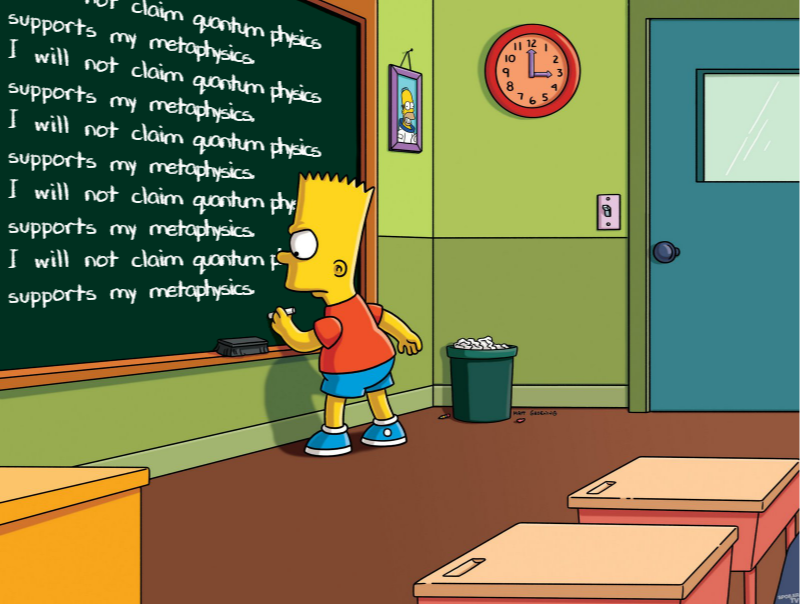
Harmonizes equally well with science. I will not (today) yield to the temptation to gesture toward the spookiness of quantum mechanics and try to wrestle that into an argument for a world made of One Mind. (I do think this intuitively; I just can’t credibly claim to understand the physics well enough to say with a straight face that it’s a worthy argument.)
Nor do I mean merely that theistic-idealist monism is a theology that refrains from asking science to endorse a soul headquartered in the pituitary gland, or a universe 6,000 years young; it does so refrain, but lots of other theologies do that, too. No, I want to say rather that science and theistic-idealist monism seem to share a central intuition that the world is unified. The search in physics for a “grand unified theory” reconciling quantum mechanics with general relativity, for example, implicitly endorses the notion that whatever the ultimate truth is, there will be One of it. Science loves reduction. Explaining a falling apple on Earth and the orbit of Venus in the heavens as resulting from one and the same force was a tour de force of reduction, and science keeps on trying to find ever more ways to explain ever more with ever less. That logically needn’t be so; one might theoretically posit some amount of plurality as brute facts. But scientists keep pursuing reduction. How far can that be taken? The simplest point of reduction cannot be zero (since Existence exists), so it’s reasonable to suspect that at the end of the day, we’re going to find One. And my contention is: That kind of prediction becomes both a scientific and a religious (monotheistic/monist) gesture, and an indication that these two ways of looking at the world are partners, not rivals.5
V. The Practical Implications
“All my days I grew up among the Sages, and I have found nothing better for the body than silence. And study is not the most important thing, but actions. And whoever multiplies words brings about sin.”
— R’ Shimon ben Gamliel, Avot 1:17
There are no practical implications of theistic-idealist monism.
Okay, that’s a little stark…
Look, I don’t know what practical implications we’re expecting. There are certainly benefits here. Theistic-idealist monism explains the interaction of matter and consciousness in a way no other theory can do. It allows us to consider multiple major philosophical problems solved, and satisfyingly so. It does all this while rowing in the same direction as science, and while simultaneously being deeply consonant with a range of religious traditions. Is that not enough for you? Do you demand more from your philosophical theories? Are you not entertained?
I will own, however, that “considering philosophical problems solved on an ultimate level” is something that, along with about six dollars, can buy you a Pumpkin Spice Latte®.
Free will: Very good to say that ultimately I’m God’s dream, or a character in God’s story, and He decides what I decide to do. Here on my level, I still have lots of hard choices to make!
Meta-ethics and moral epistemology: Is morality all nicely grounded and tucked into its theoretical bed? How splendid. Do moral relativism and moral absolutism magically reconcile in a glorious theoretical paradox? That’s nice, dear. Thinking through the hardest moral dilemmas in the real world is still agonizingly difficult!
Theodicy: Very nice to have good answers on the level of theory and philosophy about God’s ultimate level of reality. In the day-to-day, evil still palpably exists and exceedingly sucks, and to the degree we exist at all (which is to say, not ultimately, but practically) we can’t escape it by jumping up to God’s level!
Science and religion: Do we have an elegantly framed permission slip from the universe that says we can be good scientists and also faithful religionists? Phenomenal, hang it on the mantle — science still takes remarkably hard work, and proper religious devotion remains a lifelong challenge.
So okay, fine: The Solution to Everything doesn’t (practically) solve anything.
However (“Other than that, Mrs. Lincoln, how did you enjoy the play?”), for me, theistic-idealist monism is deeply satisfying, parsimonious, inspiring, and at once comforting and challenging. It yields faith but also curiosity. It suggests lines of thought and questions that feel important and real to me, and that I am still thinking through. It feels capacious but also simple, flexible but also solid. It is a friend to paradox.
That’s good enough for the likes of me.
For the rest of this post, I proceed to discuss this idea in avowedly theistic terms. That’s partly because I aesthetically prefer a religious attitude toward the ultimate reality, and partly because I think, morally and politically, a religious attitude is deeply important to society. But please note that even if you’re one of the (misguided) people who feels alienated by “God-talk,” all of these ideas are eminently translatable into the Secularese you may prefer.
My fuller 2024 musing on consciousness is here. My update, including a Twitter exchange with Prof. David Chalmers, who coined the phrase “the hard problem of consciousness,” is here. Chalmers’s 2019 paper on varieties of idealism is here. Bernardo Kastrup’s 2017 paper on this topic is here, and read R’ Samuel Lebens on “God and His Imaginary Friends” as well.
My 2025 musing on free will is here. In it, I lean heavily on the metaphor of Shakespeare and his characters. I promise you that I did not read R’ Samuel Lebens’s “God and His Imaginary Friends” (2015), which also makes use of Shakespeare and his characters to make many of the same points, until months after I had written that post! (Just as I never read Kastrup 2017 until I had already mused my way to a similar place in 2024.)
UPDATE: Here it is.
The naïve version of harmonizing religion and science is to hope some anthropologist discovers the burial site of literal Adam and Eve. A more advanced, but probably-still-doomed version is to play word games and chronology games with enough dexterity that you can force an extremely stretched reading in which Genesis 1 describes accurate astrophysics. The higher-naïve harmonization, though, is to realize that the cosmos is so deeply strange and so far beyond us (while, of course, including us) that all our most precise and empirically accurate scientific theories, no less than our oldest and most fanciful poems, are faint approximations of the ultimate reality. When contemplating the unknowable fullness of the world, we can embrace as metaphor (rather than dismissing as metaphor) science and religion alike.
Here is an argument for theistic acosmism:
Naturalism is committed to the existence to the natural world which includes several natural things such as stars, rocks, and people.
Theistic acosmism is only committed to the existence of Existence, namely God.
There is nothing naturalism explains better than theistic acosmism.
Since theistic acosmism is simpler and explains the data just as well as naturalism, naturalism should be rejected in favor of theistic acosmism.
In the Moses and the Burning Bush incident, he said to God, “Suppose I go to the Israelites and say to them, ‘The God of your fathers has sent me to you,’ and they ask me, ‘What is his name?’ Then what shall I tell them?'"
God said to Moses, “I am who I am." Moses is who he is not; Moses doesn't exist.
God said, "You shall have no other gods before me."
What about Zeus? Even if Zeus doesn't exist? What's wrong with worshipping ourselves? We don't exist either.
We should worship Existence alone because there is nothing else besides Existence to worship.
I find theistic-idealist monism close to theistic acosmism. What Santa Claus is to us is what we are to God.